
As imaging devices—such as medical scanners, industrial cameras, and high-end optical systems—become more compact and complex, ensuring the integrity of internal components is more critical than ever. Many of these devices rely on advanced packaging technologies like BGA (Ball Grid Array), where solder joints are hidden beneath the component and cannot be inspected visually.
This is where BGA X-ray machines play a vital role. By enabling non-destructive internal inspection, these systems help manufacturers maintain high quality standards while reducing the risk of hidden defects.
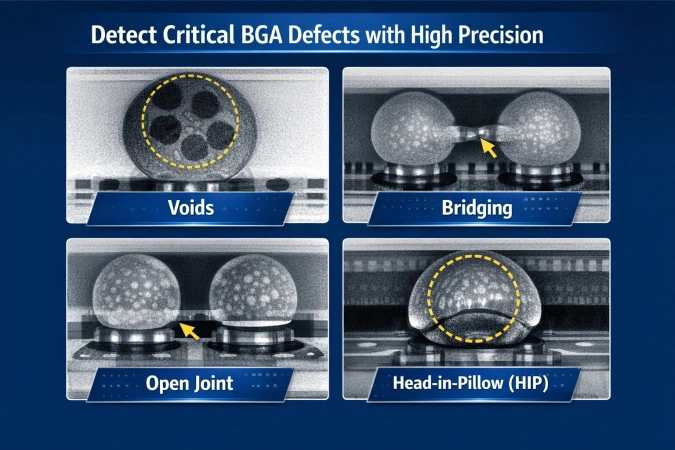
A BGA X-ray inspection system is a specialized type of PCBA inspection machine that uses X-ray imaging technology to examine solder joints, internal connections, and component structures beneath the surface of a printed circuit board assembly (PCBA).
Unlike traditional inspection methods, X-ray systems provide clear visibility into hidden areas, making them essential for detecting defects in complex electronic assemblies.
BGA X-ray machines allow manufacturers to inspect internal solder joints without damaging the product. This is especially important for high-value imaging devices where rework or replacement costs are significant.
Modern X-ray inspection systems can detect a wide range of defects, including:
Solder voids
Bridging and short circuits
Open connections
Head-in-Pillow (HIP) defects
This level of precision ensures that even microscopic issues are identified before products reach the market.
By identifying hidden defects early in the production process, manufacturers can significantly reduce failure rates in the field—an essential factor for medical and industrial imaging equipment where reliability is critical.
As packaging types such as BGA, QFN, and POP become more common, traditional inspection methods fall short. BGA X-ray machines provide the capability needed to inspect these advanced structures effectively.
With the rise of Industry 4.0, X-ray inspection machines are evolving beyond standalone equipment into intelligent systems integrated within smart factories.
Modern systems increasingly incorporate AI algorithms to:
Automatically detect and classify defects
Reduce false positives
Improve inspection consistency
For high-volume production, inline X-ray inspection systems enable real-time quality control directly on the SMT production line, ensuring 100% inspection without sacrificing throughput.
Advanced inspection systems can integrate with MES/ERP platforms, enabling:
Real-time monitoring
Process optimization
Full traceability of each PCB
When selecting a BGA X-ray inspection system, manufacturers should consider several key factors:
Resolution and magnification for detecting micro-defects
Automation level for improving efficiency
Software capabilities, including AI and image analysis
Compatibility with inline or offline production environments
A reliable and well-configured system can significantly improve both product quality and production efficiency.
Leading manufacturers such as Seamark continue to push the boundaries of BGA X-ray machine technology, focusing on higher resolution imaging, improved automation, and smarter inspection software.
By investing in advanced inspection solutions, imaging device manufacturers can stay ahead of increasing quality demands while optimizing production costs.
As imaging devices become more sophisticated, the need for accurate and reliable inspection methods continues to grow. BGA X-ray machines have become indispensable tools in ensuring product quality, detecting hidden defects, and supporting advanced electronic packaging.
For manufacturers aiming to achieve higher reliability and efficiency, integrating advanced X-ray inspection systems into the production process is no longer optional—it is essential for long-term competitiveness.
 EN
EN
 es
es  ko
ko  de
de  it
it  pt
pt  th
th  ar
ar  pl
pl  vi
vi  tr
tr  ru
ru